
Oil Painting on Watch Dials: Daigremont's Technical Breakthrough
In luxury watchmaking, dial decoration almost always relies on two processes: oven-baked enamel or acrylic paint. Two demanding techniques, each with its masters and its tradition. At Daigremont, we have taken a third path, slower and more uncertain, betting on oil painting to adorn our watch dials.

Oil paint, enamel, acrylic: why we chose oil
Enamel requires firing at 800 degrees, which freezes the color into a smooth and uniform surface. Acrylic, more flexible, dries in a few hours and lends itself to touch-ups. Two noble techniques, each with its own logic.
We made the choice of oil. A demanding choice: several weeks of drying by polymerization, no touch-ups possible once the layer is applied, and a mastery of outgassing that is essential for compatibility with the movement. But it is the only medium that restores the depth, texture, and play of light unique to easel painting. It is this living material that we wear on our wrist.
The real obstacle: making oil compatible with the movement
Drying is not the only difficulty. Oil painting poses a problem that watchmaking knows well and generally avoids: outgassing. As it polymerizes, the oil releases volatile compounds, incompatible with a mechanical movement enclosed under sapphire crystal. Add to this the brass of the dial, a smooth and non-porous surface to which the pigment has no natural reason to adhere.
We had to solve both. A specific primer coat ensures adhesion between the metal and the pictorial material. An outgassing protocol, developed through testing, guarantees that the paint is perfectly stabilized before encapsulation. It is this step, invisible and never shown, that makes oil painting viable on a mechanical watch. It also explains why so few workshops risk it.
The brilliance and micro-reliefs that capture the light
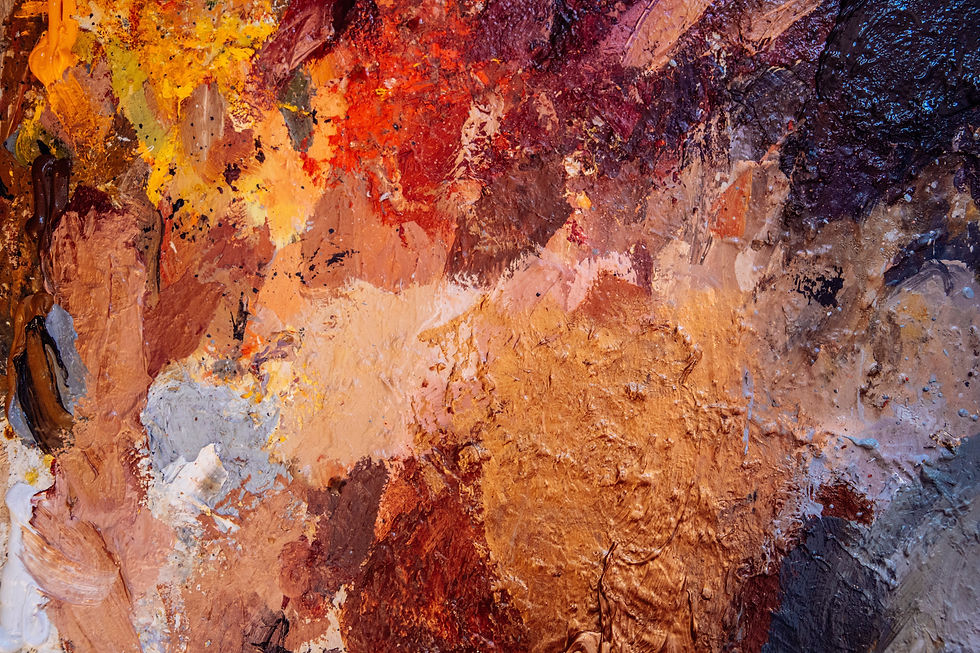
Oil painting offers a depth that enamel cannot imitate. Successive layers of pigment create micro-reliefs on the dial's surface: fine asperities left by the brush, almost invisible to the naked eye, but which catch the light differently depending on the angle of the wrist. The dial ceases to be a flat, static surface: it becomes a living material whose brilliance transforms throughout the day and according to the lighting.
The challenge of natural polymerization
Above all, this choice imposes a challenge that few manufactures accept today: time. Unlike enamel fired in a few hours or acrylic dried overnight, oil hardens through natural polymerization, a slow chemical process that spans several weeks. Each dial must rest, protected from dust and temperature variations, while the pigments and binders stabilize on their own. No shortcuts are possible: accelerating drying with heat or aggressive drying agents would dull the color and weaken the pictorial layer.
Why no varnish covers our dials
Another choice that distinguishes Daigremont is the total absence of a final varnish. Most workshops apply a protective layer that unifies the surface and erases the irregularities of the stroke. We prefer to leave the pigment bare, with no screen between the material and the light. This only became possible thanks to modern pigments formulated to resist ultraviolet rays and maintain their brilliance over time without additional protection. The dial thus keeps a raw and slightly matte appearance in places, almost tactile, which reveals the painter's hand rather than hiding it.

A deliberate standard
It is not an aesthetic whim, but a manufacturing choice. Oil imposes waiting, the irreversibility of the gesture, and sometimes the need to start over completely. We accept this because no other material gives this particular light. It is a requirement invisible at first glance, but noticeable as soon as you turn your wrist.

Frequently Asked Questions
Is oil painting on a watch dial fragile?
No. The pigments used are formulated to resist ultraviolet rays, and the paint is never exposed to the open air since it is housed under sapphire crystal in a watertight case. Once polymerization is complete, the pictorial layer is stable and does not crack. Its durability over time is comparable to that of other fine watchmaking finishes.
Why does oil paint take several weeks to dry?
Unlike enamel, which requires baking in a high-temperature kiln, oil paint dries naturally at room temperature. This slow polymerization process, which can last several weeks depending on the thickness of the layer, is what gives the material its unique depth and micro-reliefs. It is a choice of patience rather than industrial speed.
What is the difference between an oil-painted dial and an enameled dial?
Enamel is applied and then fired at a very high temperature, producing a smooth, uniform, and perfectly reproducible surface from one dial to the next. Oil paint, on the other hand, dries slowly in the open air without protective varnish, revealing subtle variations in material and relief that make each dial slightly unique. It is this mastered imperfection that we seek at Daigremont.
How to maintain an oil-painted watch dial?
No special maintenance is required. The dial is protected by the sapphire crystal and never comes into contact with the air or the elements. The precautions to take are those of any well-cared-for mechanical watch: avoid violent shocks and extreme temperatures. The paint itself does not move.


Comments