
The Art of Miniature Painting: When the Sundial Becomes a Masterpiece
In the world of watchmaking, technology often reigns supreme. Tourbillons, chronographs, and power reserves fascinate with their mechanical complexity. Yet, there is another form of complexity, more poetic and visual, that transforms a simple watch into a unique work of art: miniature painting .
At Daigremont Watches , we collaborate with artists capable of capturing emotion on a surface barely exceeding a few square centimeters. But what makes this art so precious and so demanding? A dive into the infinitely small.
A challenge on a millimeter scale
Imagine having to reproduce Girl with a Pearl Earring or a realistic portrait of a loved one on a surface the size of a coin. Miniature painting is not simply painting on a "smaller" scale; it is a discipline that demands a complete overhaul of artistic technique.
The support — the watch face — imposes its constraints:
Size: With an average diameter of 30 to 40 mm, each brushstroke should be invisible to the naked eye.
Thickness: The layer of paint must not impede the movement of the hands. The artist is working on microns.

Extreme precision tooling
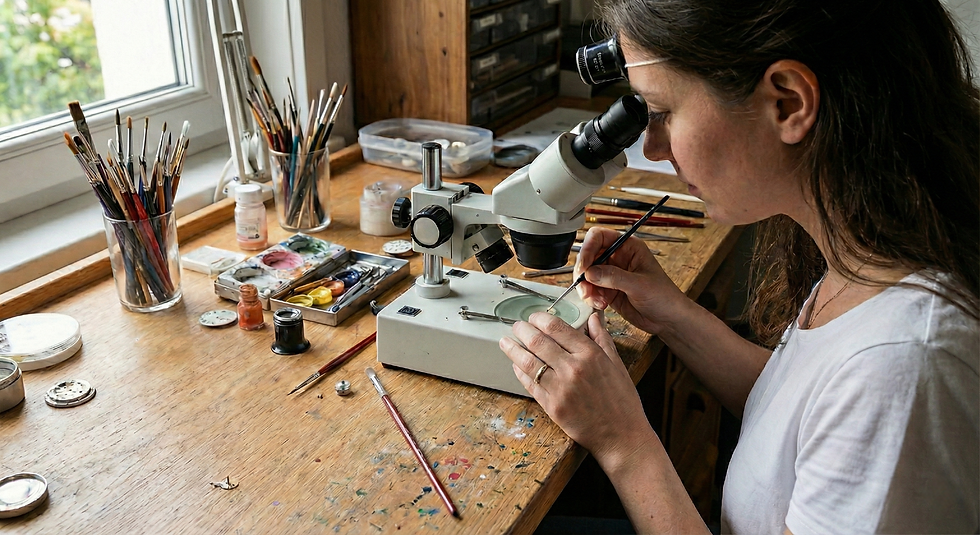
Forget wide brushes and large easels. The miniature painter's studio is more like a scientific laboratory.
The binocular microscope: The artist constantly works under a microscope or binocular magnifier. What appears to be a smooth line to the naked eye is, under the lens, a succession of microscopic dots.
The sable brush: Often reduced to a few hairs (sometimes only one!), it allows pigments to be deposited with surgical precision.
Body control: This is undoubtedly the most impressive tool. To draw a perfect line at this scale, the artist must control their breathing and paint very slowly to avoid the slightest micro-vibration.
Hours of patience for a unique soul
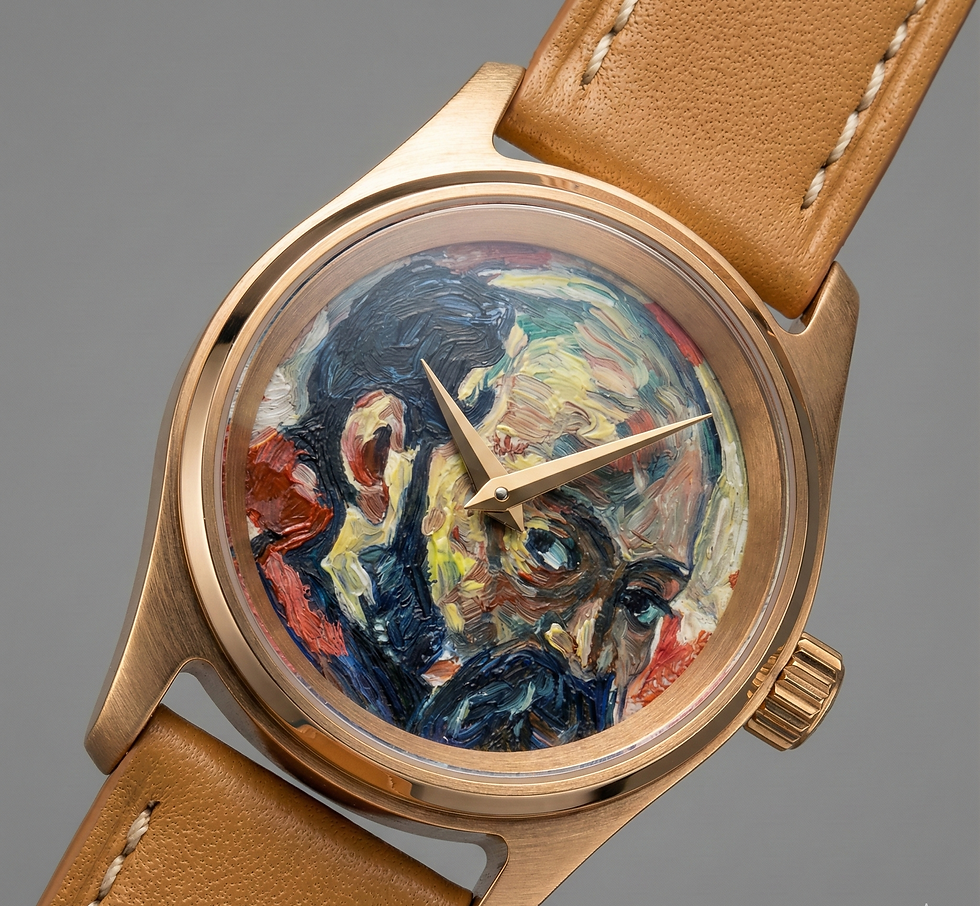
Creating a hand-painted dial is a celebration of slowness. Unlike industrial printing, a miniature painting requires dozens, sometimes hundreds of hours of work.
Each color must be applied, dried (or fired, depending on whether it is enamel or lacquer), and then reworked. The grisaille technique (often used for portraits or black and white works), for example, requires gradually building up the highlights on a dark background, layer by layer, to create volume and life.
The slightest speck of dust or the slightest tremor in the final stage can ruin weeks of work. It is this risk-taking and human investment that give the final piece its value.
Why choose a hand-painted watch?
In a standardized world, wearing a hand-painted watch is the ultimate expression of personal luxury. It's not a watch you'll see on anyone else's wrist.
Emotion: Whether it's a reproduction of a masterpiece, a landscape dear to your heart, or a personal tribute, the dial becomes a guardian of memory.
Exclusivity: As each brushstroke is applied by hand, even two watches depicting the same subject will have minute variations. Your watch is, by definition, unique.
At Daigremont Watches , we connect your desires with the talent of exceptional miniature painters. We transform passing time into enduring art.
Do you have a project in mind? A piece you dream of wearing? Contact us to discuss the creation of your unique item.


Comments